 how-to
How to Maintain Automated Gates: A Step-by-Step Guide
Quick Summary
To maintain automated gates, inspect the tracks, hinges, safety photocells, wiring, gate balance and control board on every visit, and clear debris before it causes damage. Test the auto-reverse feature each time, since a blocked sensor can let the gate close on a car, child or pet.
- Clear grit, leaves and debris from tracks and rollers on every visit.
- Check hinges and pivots for rust, cracks or loose bolts.
- Wipe photocell lenses and confirm the beam is clear.
- Test auto-reverse at every inspection.
- Avoid heavy grease on tracks, since it traps grit and turns sticky.
Table of Contents
- Electric Gate Maintenance Checklist: What to Inspect Each Visit
- Best Lubricant for Gate Hinges, Rollers and Tracks
- Gate Maintenance Frequency and When to Book Automated Gate Repair Services
- Frequently Asked Questions
Electric Gate Maintenance Checklist: What to Inspect Each Visit
Last Updated: November 4, 2026
Automated gates work hard daily, and small problems grow fast when unchecked. A quick, regular inspection is how you maintain automated gates and catch worn parts before they leave you stuck at the curb.
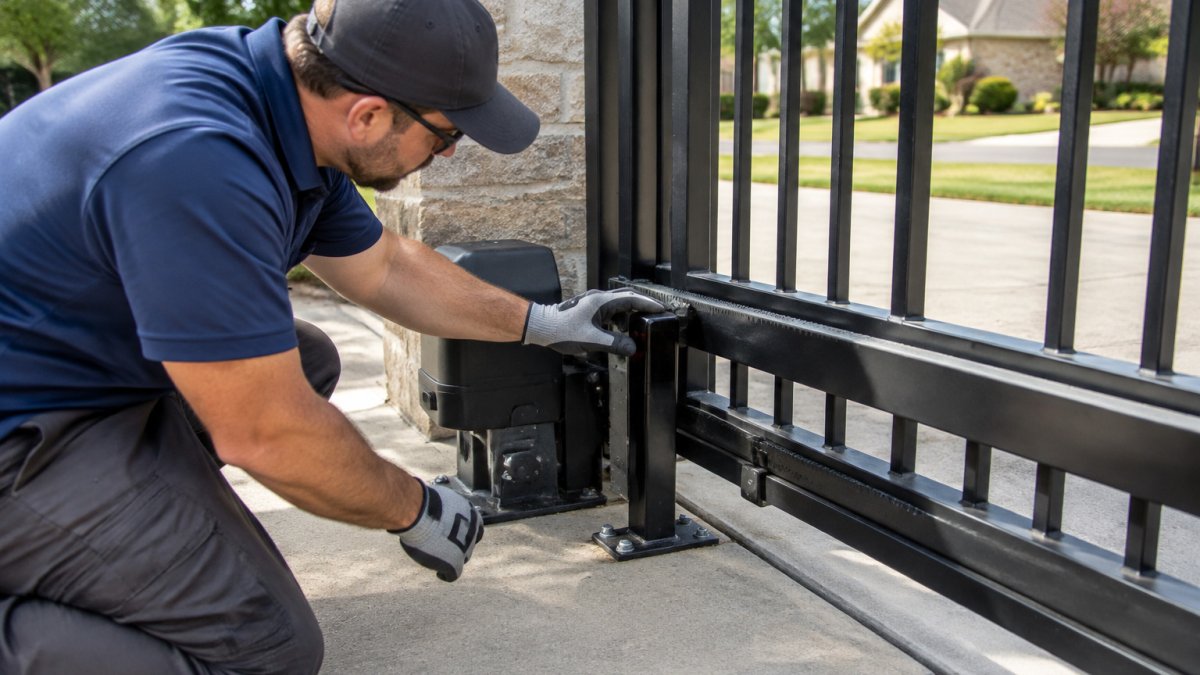
Use this checklist on every visit:
- Tracks and rollers: Clear grit, leaves and debris
- Hinges and pivots: Check for rust, cracks or loose bolts
- Safety photocells: Wipe lenses and confirm the beam is clear
- Wiring: Look for fraying, cracked insulation and corrosion
- Gate balance: Move the gate by hand and watch for drag or sagging
- Control board and clutch: Listen for grinding, clicking or slow response
Watch the safety photocells closely: a blocked or misaligned sensor can let the gate close on a car, child or pet. Test auto-reverse every inspection.
Use this table to see what to inspect on each visit and what to look for.
| Component | What to check | Warning sign |
|---|---|---|
| Tracks and rollers | Clear grit, leaves and debris | Grit buildup |
| Hinges and pivots | Rust, cracks or loose bolts | Rust, cracks or loose bolts |
| Safety photocells | Wipe lenses and confirm the beam is clear | Blocked or misaligned sensor |
| Wiring | Fraying, cracked insulation and corrosion | Fraying or corrosion |
| Gate balance | Move the gate by hand | Drag or sagging |
| Control board and clutch | Listen for grinding, clicking or slow response | Grinding, clicking or slow response |
Best Lubricant for Gate Hinges, Rollers and Tracks
Avoid heavy grease on tracks, it traps grit and turns sticky. Wipe off old residue, then apply a thin, even coat.
Gate Maintenance Frequency and When to Book Automated Gate Repair Services
Request a quote from Pro Access Industries to have your system inspected and repaired.
Call a professional right away if you notice any of these signs:
- The gate stops partway through its travel
- The motor hums but the gate does not move
- The gate reverses for no clear reason
- You smell burning or see sparks from the control box
Do not attempt electrical repairs yourself, live wiring or the control board can cause serious injury. A qualified technician can diagnose the problem safely. To weigh repair against replacement, see what owning and servicing an automated gate costs over time.
Frequently Asked Questions
Do automatic gates need servicing?
Yes. Automated gates have motors, limit switches, safety sensors and moving hardware that wear over time. Routine service catches small problems such as a sagging gate, a dirty photocell or a loose connection before they cause a failure or a safety hazard. Most owners benefit from a professional inspection at least once a year, with more frequent checks for heavily used commercial or industrial gates. Request a quote from Pro Access Industries for an accurate figure based on your system and scope.
Can I perform automated gate maintenance myself?
Many owners handle basic tasks themselves: wiping down tracks, clearing debris, lubricating hinges and testing the safety reverse by placing an object in the gate's path. Electrical work, motor adjustments, clutch and control board testing, and any repair involving the gate operator should be left to a qualified technician. Working on live wiring or a gate that moves unexpectedly can cause injury. If a test fails or the gate behaves oddly, stop and call a professional.
What are the signs that my gate opener needs repair?
Watch for a gate that stops partway, reverses without an obstruction, opens slowly or unevenly, makes grinding or squealing noises, or fails to respond to the remote or keypad. Other warning signs include a gate that sags or rubs on the ground, a safety sensor that stays inactive, or a manual release that is hard to operate. Any of these symptoms calls for prompt service, because a gate that fails to detect an obstruction is a safety risk. Pro Access Industries offers same-day repair for all brands.